Wrap up
Markus Steiner
Institute for Mental and Organisational Health, FHNW
06 June, 2025
Alternative and Equivalent Models
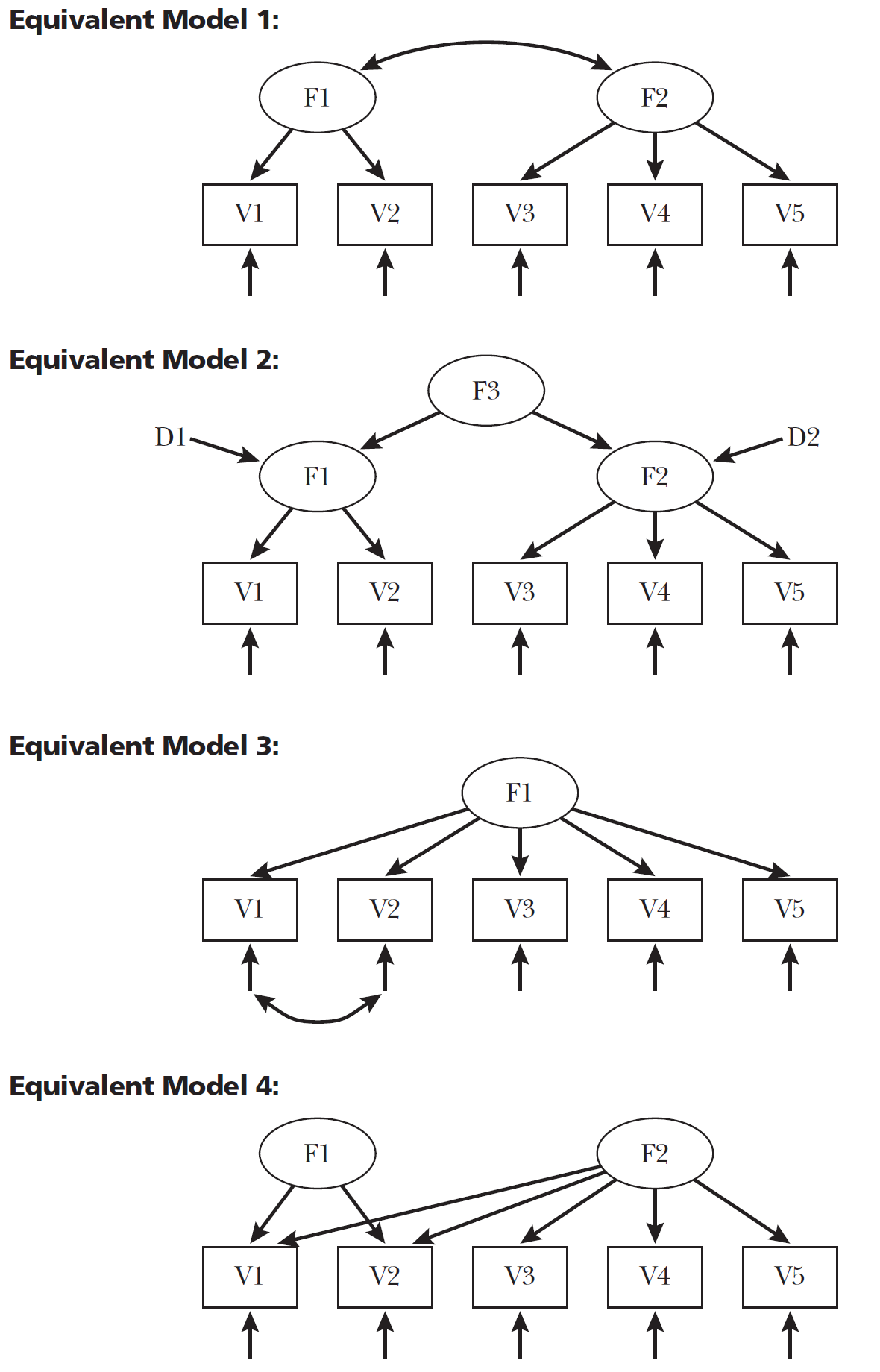
EFA vs. CFA revisited
Nájera et al. (2025) suggest that CFA might be overly strict
- in presence of cross-loadings
- in presence of slight misspecifications
- leading to biased parameter estimates.
Alternatively, they suggest the usage of
- EFA (best in one sample and then CFA in another sample)
- ECFA (first EFA, determine substantial loadings acc. to spec. rules, then fit a CFA)
Some Things to Consider
- Tradeoff between internal consistency and predictive validity (Revelle, 2024; White, 2025)
- The more similar (correlated) items are, the higher internal consistency, but the lower the increase in predictive validity.
- Formative (descriptive) vs. reflective (causal) factors.
- Higher-order factors need not be causal: Overlapping processes can lead to higher-order structure (Kovacs & Conway, 2016, 2019; Revelle, 2024)
- For a discussion of formative indicators, see Bollen & Diamantopoulos (2017).
Further Ressources
(CB-)SEM
PLS-SEM
- Constructs as weighted composites (vs. explaining covariation between indicators).
- Prediction and explanation of target constructs.
- Non-parametric method: No distributional assumptions
- Can easily model formative constructs.
- Higher power than CB-SEM
- Cannot model error terms (e.g. covariation of errors)
- No overall GOF
- No easy model comparisons to alternative models
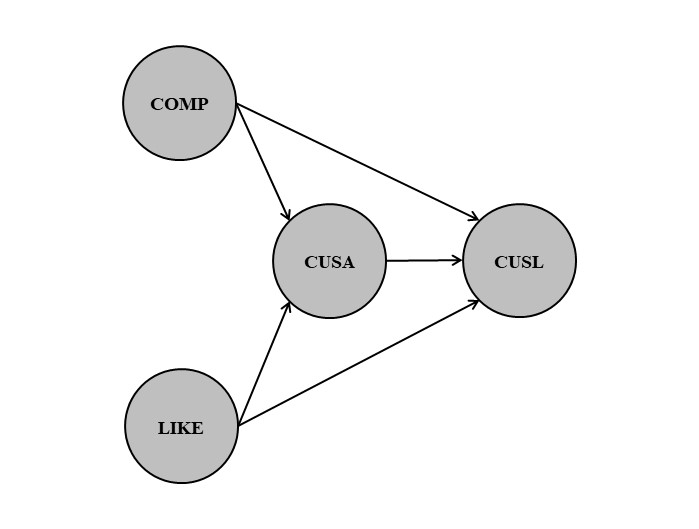
Example: Corporate reputation model
# measurement model
corp_rep_mm <- constructs(
  composite("COMP", multi_items("comp_", 1:3)),
  composite("LIKE", multi_items("like_", 1:3)),
  composite("CUSA", single_item("cusa")),
  composite("CUSL", multi_items("cusl_", 1:3)))

# structural model
corp_rep_sm <- relationships(
  paths(from = c("COMP", "LIKE"),
        to = c("CUSA", "CUSL")),
  paths(from = c("CUSA"), to = c("CUSL")))

# model estimation
estimate_pls(data = seminr::corp_rep_data,
             measurement_model = corp_rep_mm,
             structural_model  = corp_rep_sm,
             inner_weights = path_weighting,
             missing = mean_replacement,
             missing_value = "-99")
PLS-SEM
- Ressources:
- Hair et al. (2017)
- Hair et al. (2021)
{seminr}(Ray et al., 2024)
Example: Corporate reputation model
References
Bollen, K. A., & Diamantopoulos, A. (2017). In Defense of Causal-Formative Indicators: A Minority Report. Psychological Methods, 22(3), 581–596. https://doi.org/10.1037/met0000056
Brown, T. A. (2015). Confirmatory Factor Analysis for Applied Research (2nd ed.). The Guilford Press.
Fabrigar, L. R., & Wegener, D. T. (2012). Exploratory Factor Analysis. Oxford University Press.
Hair, J. F., Hult, G. T. M., Ringle, C. M., & Sarstedt, M. (2017). A primer on partial least squares structural equation modeling (PLS-SEM) (Second edition). SAGE.
Hair, J. F., Hult, G. T. M., Ringle, C. M., Sarstedt, M., Danks, N. P., & Ray, S. (2021). Partial Least Squares Structural Equation Modeling (PLS-SEM) Using R: A Workbook. Springer International Publishing. https://doi.org/10.1007/978-3-030-80519-7
Hancock, G. R., & Mueller, R. O. (2013). Structural equation modeling. A second course. Information Age Publishing Inc.
Hershberger, S., & Marcoulides, G. A. (2013). The problem of equivalent structural models. In G. R. Hancock & R. O. Mueller (Eds.), Structural Equation Modeling. A second course (2nd ed.). Information Age Publishing Inc.
Kline, R. B. (2023). Principles and practice of structural equation modeling (5th ed.). The Guilford Press.
Kovacs, K., & Conway, A. R. A. (2016). Process Overlap Theory: A Unified Account of the General Factor of Intelligence. Psychological Inquiry, 27(3), 151–177. https://doi.org/10.1080/1047840X.2016.1153946
Kovacs, K., & Conway, A. R. A. (2019). A unified cognitive/differential approach to human intelligence: Implications for IQ Testing. Journal of Applied Research in Memory and Cognition, 8(3), 255–272. https://doi.org/10.1016/j.jarmac.2019.05.003
Lee, S., & Hershberger, S. (1990). A Simple Rule for Generating Equivalent Models in Covariance Structure Modeling. Multivariate Behavioral Research, 25(3), 313–334. https://doi.org/10.1207/s15327906mbr2503_4
Nájera, P., Abad, F. J., & Sorrel, M. A. (2025). Is exploratory factor analysis always to be preferred? A systematic comparison of factor analytic techniques throughout the confirmatory–exploratory continuum. Psychological Methods, 30(1), 16–39. https://doi.org/10.1037/met0000579
Ray, S., Danks, N. P., & Calero Valdez, A. (2024). Seminr: Building and Estimating Structural Equation Models (p. 2.3.4). Comprehensive R Archive Network.
Revelle, W. (2024). The seductive beauty of latent variable models: Or why I don’t believe in the Easter Bunny. Personality and Individual Differences, 221, 112552. https://doi.org/10.1016/j.paid.2024.112552
White, M. (2025). A peculiarity in psychological measurement practices. Psychological Methods. https://doi.org/10.1037/met0000731

Introduction to Factor Analysis - GSP 2025